



An ecommerce SEO agency helps online stores attract customers through search engines, improve product visibility, and generate more sales. Whether you run a Shopify store in London, a WooCommerce business in Sydney, or an online retail brand in New York, the right SEO strategy can support sustainable growth.
However, appearing on Google is only part of the challenge. Your website must also help shoppers find products, compare options, and complete purchases.
That’s why effective eCommerce SEO combines technical optimization, relevant content, and an excellent shopping experience.
An ecommerce SEO agency specialises in improving the organic search performance of online stores. It optimises product pages, category structures, technical SEO, and commercial keywords to attract potential buyers. A professional agency also measures organic conversions and revenue, helping retailers connect search visibility with meaningful business results.
Key Takeaways
An ecommerce SEO agency provides specialised search engine optimisation services for businesses selling products online.
Unlike general SEO, ecommerce optimization focuses heavily on product discovery, shopping intent, category architecture, and purchase-related search queries.
For example, someone searching for “comfortable running shoes” may still be researching products. Meanwhile, a search for “buy men’s running shoes size 10” suggests more specific purchase intent.
A professional ecommerce SEO agency identifies these differences and creates an appropriate page strategy.
Its services typically include:
These activities help search engines understand products while making shopping easier for customers.
Traditional SEO and ecommerce SEO share the same foundations. However, their priorities often differ.
| Traditional SEO | Ecommerce SEO |
| Focuses on services and information | Focuses on products and purchases |
| Optimises service and blog pages | Optimises product and category pages |
| Tracks leads and enquiries | Tracks orders and revenue |
| Manages smaller page collections | Often manages large product catalogues |
| Targets broad search intent | Prioritises commercial shopping intent |
Therefore, online retailers benefit from a strategy designed around how people search for and purchase products.
An ecommerce SEO agency increases sales opportunities by improving product discoverability and the customer journey.
However, rankings alone cannot guarantee purchases. Product quality, pricing, delivery policies, and website usability also influence conversions.
Effective ecommerce keyword research connects search phrases with the correct products and categories.
An online skincare business might target:
Each query reflects a different customer need.
Commercial keywords usually belong on relevant product or category pages. Informational searches may be better suited to buying guides or educational articles.
Importantly, keyword research should consider relevance, competition, and expected business value.
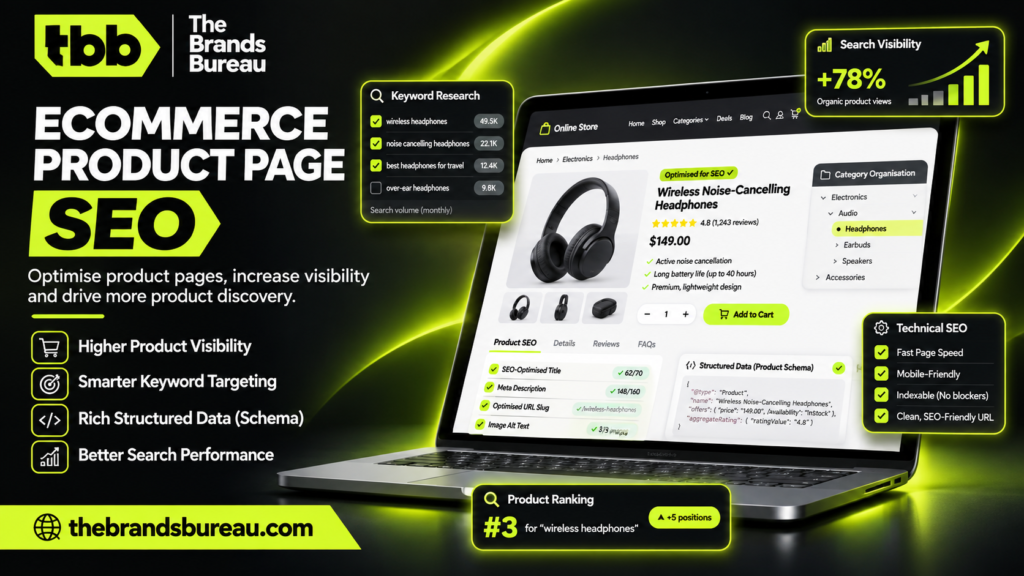
Product pages are essential because they help shoppers evaluate individual items.
A well-optimised product page should include:
Category pages serve a different purpose.
They help customers browse groups of products and discover relevant alternatives.
For example, an online furniture store might create a “Modern Dining Tables” category. That page should contain useful introductory information, relevant product links, and intuitive filtering options.
Avoid filling category pages with repetitive paragraphs written only for search engines.
Instead, provide information that genuinely helps customers choose products.
Large ecommerce websites can develop technical problems as their product catalogues expand.
Common challenges include duplicate URLs, unavailable products, faceted navigation, incorrect canonical tags, and inaccessible category pages.
A technical eCommerce SEO audit should review:
According to Google Search Central, ecommerce navigation and internal links help Google understand the relationship between category and product pages.
For example, important products should be reachable through normal navigation rather than relying entirely on internal search functions.
Practical tip: Check your highest-revenue categories first. Fixing problems on commercially important pages can create more useful opportunities than optimising low-priority content.
Ecommerce SEO creates opportunities to reach shoppers who are actively looking for products.
It can also support customer acquisition without requiring payment for every organic search click.
SEO and PPC advertising support different stages of business growth.
Google Ads and Meta Ads can help businesses test offers, reach selected audiences, and generate paid traffic.
Meanwhile, SEO supports longer-term organic discoverability.
For example, a UK clothing brand could use paid campaigns to promote a seasonal collection. At the same time, it could optimise evergreen category pages for relevant product searches.
Combining these approaches creates a more balanced marketing strategy.
Product structured data helps Google understand information about items sold online.
Relevant markup can describe product names, prices, availability, reviews, and shipping information.
Google also recommends sharing product data through suitable Merchant Center integrations.
Correct implementation can make eligible products appear in richer search and shopping experiences.
However, structured data does not guarantee enhanced search visibility.
An ecommerce SEO agency should measure results that matter to the business.
Consider this illustrative example:
An online store receives 5,000 organic visitors monthly.
If 2% complete a purchase, that produces 100 orders.
With an average order value of £60, the store generates £6,000 in monthly organic revenue.
If conversion rates improve to 2.5%, the same traffic produces 125 orders and £7,500 in revenue.
That represents a £1,500 increase without additional visitors.
These figures are hypothetical, but they demonstrate an important principle.
Increasing qualified traffic and improving conversion rates can work together to support ecommerce growth.
Useful performance indicators include organic revenue, conversion rate, average order value, product engagement, and customer acquisition costs.
The best agency for your business depends on your ecommerce platform, product catalogue, goals, and available budget.
Businesses using Shopify, WooCommerce, Magento, or Adobe Commerce may require different technical solutions.
Before hiring an ecommerce SEO agency, evaluate these factors.
1. Ecommerce experience: Ask whether the provider understands product variants, category architecture, and online shopping behaviour.
2. Technical expertise: Review its approach to crawling, indexing, structured data, and mobile performance.
3. Content strategy: Look for original product information and useful buying guides rather than mass-produced descriptions.
4. Reporting: Ensure the agency connects SEO performance with actual sales and revenue.
5. Ethical practices: Avoid guaranteed rankings, manipulative backlinks, and low-value content schemes.
6. Communication: Choose a partner that explains recommendations clearly and provides realistic expectations.
Different retail businesses need different approaches.
Ecommerce startups often need keyword mapping, category planning, and technical foundations.
Established online retailers may prioritise content improvements, product indexing, and organic revenue growth.
International ecommerce stores often require regional keyword research, language targeting, and carefully structured international URLs.
For example, a brand selling in the UK, USA, and Australia should review regional search intent, currency, delivery information, and customer expectations.
Duplicating nearly identical location pages without meaningful differences is not a strong long-term strategy.
At The Brands Bureau, we combine search engine optimisation, website development, content marketing, branding, and performance marketing.
Our approach focuses on identifying relevant search opportunities and improving the customer journey.
For ecommerce businesses, this means looking beyond individual keywords.
We consider how shoppers discover products, navigate websites, and move toward purchasing decisions.
Whether you’re launching a new online store or improving an established ecommerce business, a structured digital strategy can help you plan your next steps.
A professional ecommerce SEO agency helps businesses improve product visibility, attract qualified shoppers, and create opportunities for increased sales.
However, sustainable growth requires more than rankings. It depends on useful product content, technical reliability, effective navigation, and a smooth shopping experience.
At The Brands Bureau, we help businesses explore SEO, website development, and digital marketing strategies aligned with their growth objectives.
Ready to improve your ecommerce store’s visibility and sales opportunities?
Visit to explore our digital marketing solutions.
The Brands Bureau — We Build. We Market. You Grow.
An ecommerce SEO agency helps online retailers improve organic search visibility and attract customers looking for their products. Its services usually include keyword research, product page optimisation, technical SEO, category development, and performance reporting. The goal is to connect relevant search demand with useful shopping experiences and measurable business outcomes.
Ecommerce SEO pricing depends on catalogue size, competition, technical complexity, and required services. Smaller stores may need focused audits and optimisation, while larger retailers often require ongoing technical and content support. Businesses should request a detailed proposal covering implementation, reporting, maintenance, and any additional costs before choosing a provider.
Ecommerce SEO results depend on website condition, competition, existing search visibility, and implementation quality. Some technical improvements may show changes relatively quickly, while competitive category rankings can take several months or longer. Businesses should monitor impressions, organic traffic, product engagement, and revenue rather than expecting immediate ranking guarantees.
Shopify and WooCommerce follow similar SEO principles, including useful content, proper indexing, internal links, and mobile performance. However, their technical implementations differ. Shopify has platform-specific URL and template behaviour, while WooCommerce offers different WordPress-based controls. An experienced ecommerce SEO agency should adapt its recommendations to each platform.
Yes. Smaller ecommerce businesses can target specific product categories, specialised searches, and underserved customer needs. For example, a niche retailer may find opportunities through detailed product guides and long-tail keywords. However, success depends on competition, product relevance, website quality, and consistent optimisation rather than business size alone.
About the Author
Zeeshan Shafiq | SEO & Digital Marketing Strategist
Zeeshan Shafiq is an SEO and Digital Marketing Strategist at The Brands Bureau, specialising in ecommerce SEO, technical SEO, content marketing, AI-driven search optimisation, and digital growth strategies.
With expertise in Google Search Console, Yoast SEO, RankMath, and data-driven marketing, Zeeshan helps businesses improve search engine visibility, attract qualified organic traffic, generate leads, and achieve sustainable online growth.
Website: https://thebrandsbureau.com/

Leave A Reply Now