



If you’re comparing SEO services in UK, the right price depends on what your website needs, how competitive your market is, and whether you’re targeting one local area or the whole country. Current UK pricing guides show substantial variation, from several hundred pounds per month for limited local work to several thousand pounds for competitive national campaigns.
what professional SEO Services should include, how UK pricing works, what changes for London and Manchester businesses, and how to compare SEO agencies without choosing on price alone.
SEO services in the UK usually combine technical SEO, on-page optimisation, content, authority building, local search work and performance measurement. The exact mix should depend on the business rather than a fixed checklist sold to every client.
A proper SEO campaign can include:
Google’s own Search Essentials emphasise helpful, reliable, people-first content, crawlable links, accessible content and compliance with technical and spam requirements.
For that reason, SEO should not mean simply publishing articles around keywords. A business can publish dozens of pages and still have fundamental problems with its website structure, content quality, search intent or conversion journey.
A useful SEO proposal should tell you:
Expert insight: For most growing businesses, a smaller number of well-prioritised improvements is more useful than a large monthly list of activities that never connects to leads, sales or enquiries.
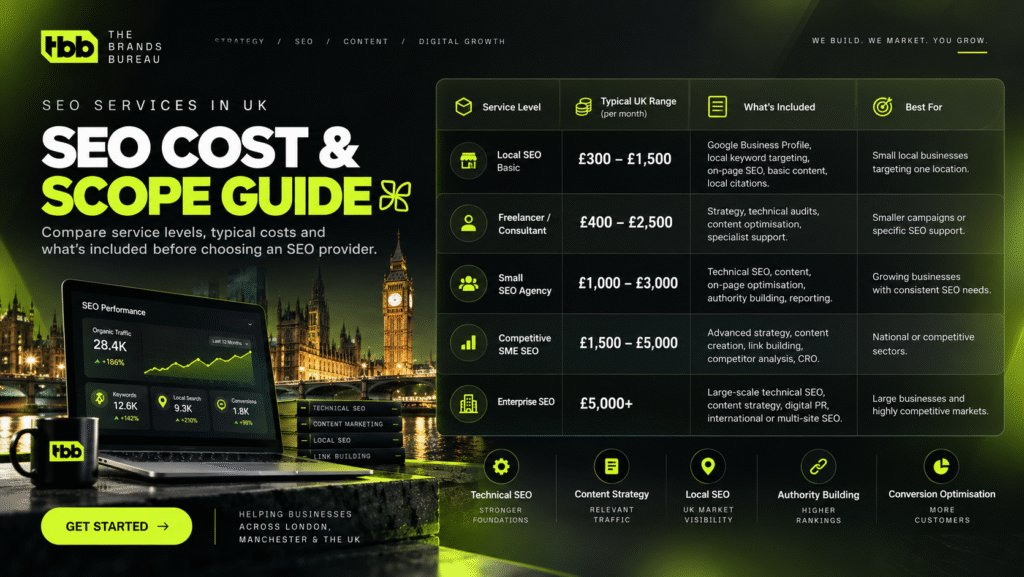
There is no single standard SEO price in the UK. Published 2026 pricing guides show different ranges because agencies and consultants package different levels of strategy, content, technical work and authority building.
For example, recent UK pricing guides report ranges such as:
| SEO option | Published 2026 range* | Typical use |
| Basic/local SEO | Around £300–£1,500/month | Small local businesses |
| Freelancer/consultant | Around £400–£2,500/month | Smaller campaigns or specialist support |
| Small SEO agency | Around £1,000–£3,000/month | Growing businesses |
| Competitive SME SEO | Around £1,500–£5,000/month | National or competitive sectors |
| Enterprise SEO | £5,000+/month | Large sites and competitive markets |
*These are published market ranges from UK SEO pricing guides, not The Brands Bureau’s pricing. Different sources use different methodologies, scopes and definitions, so they should be treated as benchmarks rather than a universal rate card.
Your monthly cost can increase when you have:
A small Manchester service business targeting a handful of local searches has very different requirements from an e-commerce company competing nationally.
Expert insight: Don’t ask an agency only, “How much does SEO cost?” Ask, “What exactly will you do for this budget, and which business outcome is each activity designed to support?”
The right SEO provider should match your market, website, objectives and internal resources—not simply have the cheapest monthly package. A good comparison starts with the work included in the proposal.
Ask whether the provider will review:
Google says pages need to meet its technical requirements and be eligible for normal Search appearance before they can be considered for AI Overviews or AI Mode. Google also says there are no additional technical requirements specifically for AI features.
A serious SEO agency should explain how it decides:
Google’s people-first guidance specifically asks publishers to consider whether content demonstrates first-hand expertise and whether visitors will leave with enough information to accomplish their goal.
Ranking positions can matter, but they aren’t the entire business outcome.
A useful SEO dashboard can track:
Expert insight: A keyword moving from position 48 to position 12 may be encouraging, but a business should ultimately care whether the visibility creates meaningful opportunities.
London and Manchester businesses don’t need completely different SEO principles, but their local competition, search behaviour and geographic targeting can change the strategy.
A local campaign might target searches such as:
The important distinction is between creating a genuinely useful location-focused service page and simply replacing a city name throughout identical copy.
Google’s current guidance warns against creating large amounts of content primarily to manipulate rankings. Its generative AI guidance also specifically cautions against creating separate pages for every possible search variation when those pages provide little additional value.
For a local business, SEO may include:
The Brands Bureau’s own service portfolio spans branding, web development, UI/UX, digital marketing and SEO-related work, which can be useful when a business needs its website and marketing activity addressed together rather than treating SEO as an isolated task.
Expert insight: A London business shouldn’t create five near-identical pages simply because five London boroughs have search volume. Build a location page when the business can provide genuinely useful information, services or evidence for that location.
A professional SEO agency should give you a clear strategy, defined deliverables, transparent reporting and an explanation of what is changing on your website. You should not have to guess what your monthly retainer is buying.
A typical engagement can move through these stages:
The agency examines your website, competitors, search visibility, technical setup, existing content and business objectives.
The team identifies valuable search topics based on:
The agency fixes or prioritises issues that can prevent search engines from properly discovering, understanding or serving important pages.
Existing pages may be rewritten or expanded, while genuinely useful new content can address gaps in the customer’s search journey.
Depending on the campaign, this can include digital PR, partnerships, relevant mentions and legitimate link acquisition.
The agency reviews performance and adjusts priorities based on evidence.
Google recommends using Search Console to monitor Search performance and diagnose potential issues. Google also explains that traffic from AI features is included in the overall Web search reporting in Search Console.
Expert insight: The strongest SEO process is iterative. Search data should influence what happens next instead of an agency following a fixed 12-month checklist regardless of what the data shows.
The most expensive SEO mistakes usually come from choosing activities before defining the business objective. Businesses can spend months producing content while important technical, commercial or conversion problems remain unresolved.
Common mistakes include:
A low retainer can be appropriate for a narrowly defined local project. It becomes a problem when the promised scope requires more strategic, technical or content work than the budget can realistically support.
SEO depends on crawling, indexing, competition, content quality, authority and changes in search demand. No legitimate agency can guarantee a specific Google ranking.
A monthly article count is not an SEO strategy.
One carefully researched page that answers an important customer question can be more useful than several generic posts written only because the contract says “four blogs per month.”
“SEO London”, “SEO Manchester”, “SEO Birmingham” and dozens of nearly identical variations can become low-value content if they don’t serve distinct user needs.
Traffic isn’t the final destination. If a website attracts relevant visitors but makes it difficult to request a quote, call, book or purchase, more traffic may not solve the underlying business problem.
Google’s current documentation says the existing SEO fundamentals remain relevant to AI Overviews and AI Mode. It also states that there are no special AI files or schema requirements needed to appear in these features.
SEO agency reviews can help you shortlist providers, but reviews should be only one part of your decision. A large review count doesn’t automatically tell you whether an agency understands your industry, website or commercial goals.
When comparing an SEO services company in UK, look for evidence across several areas:
| What to compare | Questions to ask |
| Strategy | Is there a documented plan? |
| Technical SEO | Will the website actually be audited and improved? |
| Content | Who researches and writes it? |
| Local SEO | Is location targeting relevant to your business? |
| Reporting | What metrics will you receive? |
| Communication | Who handles your account? |
| Commercial goals | Are enquiries, sales or leads considered? |
| Transparency | Can you see what work was completed? |
| Contracts | What are the terms and exit conditions? |
| Claims | Does the agency avoid guaranteed rankings? |
You can also ask for examples of relevant work. The Brands Bureau publicly presents projects covering branding, websites, apps and digital products, including work for ADRYD, TAXX OIL, Facility.pk and several hospitality brands.
Imagine a Manchester-based commercial cleaning company receives 300 organic visits a month but very few enquiries.
An SEO provider could immediately suggest publishing more blog posts.
A better diagnostic would first ask:
The answer may be that the business needs better service pages and conversion paths before it needs a large content programme.
That is the difference between doing SEO tasks and building an SEO strategy.
The Brands Bureau combines SEO with branding, web development, UI/UX, digital marketing and other digital services, allowing businesses to address search visibility alongside the website and brand experience. The agency describes its broader proposition as building, marketing and helping businesses grow through creative digital solutions.
For a UK business, that can be relevant when SEO problems overlap with other digital problems.
For example:
SEO + Website Development
A technically weak or poorly structured website may require development work alongside SEO.
SEO + Branding
A business competing in a crowded market may need clearer positioning and stronger brand communication, not just more search traffic.
SEO + UI/UX
A website can attract visitors but lose enquiries if navigation, content hierarchy or calls to action are weak.
SEO + Digital Marketing
Organic search can work alongside paid advertising, social media and content marketing as part of a broader acquisition strategy.
The Brands Bureau’s portfolio demonstrates this combined approach across branding, web development, UI/UX and digital marketing projects.
Expert insight: SEO works best when it is connected to the rest of the customer journey. Search visibility gets people to the website; the website, brand and offer give them a reason to take the next step.
The following matrix is a practical planning framework rather than a claim about a fixed industry tariff.
| Business situation | SEO priority | Typical scope |
| Single-location local business | Local visibility | GBP, local pages, technical basics, reviews, on-page SEO |
| London/Manchester SME | Regional competition | Technical SEO, commercial pages, local SEO, content, authority |
| National UK business | National visibility | Technical SEO, content strategy, authority, commercial landing pages |
| E-commerce brand | Product/category visibility | Technical SEO, category optimisation, product architecture, content |
| Large organisation | Scale and governance | Technical SEO, templates, international/local targeting, analytics |
| New website | Foundation | Architecture, indexability, keyword mapping, content structure |
This framework helps answer a more useful question than “What is the cheapest SEO package?”
The question is:
What level of SEO work does this website actually require to compete for commercially valuable searches?
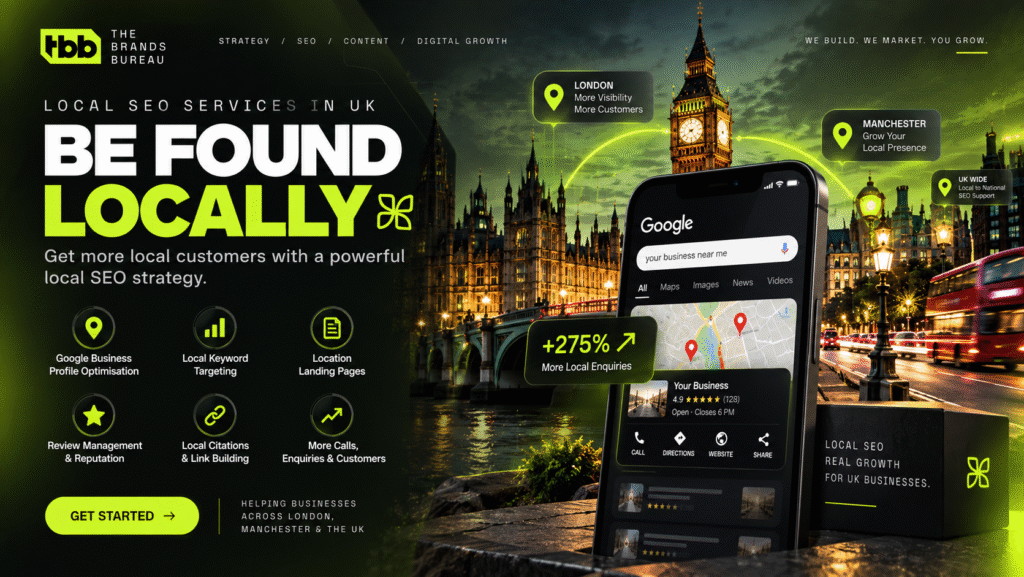
Choosing SEO services in UK should start with your business objectives, not a generic package or a promised ranking. Compare the technical work, content strategy, local SEO capabilities, reporting, communication and commercial focus behind each proposal. Current UK pricing guides show that SEO costs vary substantially because the scope varies just as much.
For businesses targeting London, Manchester or the wider UK market, The Brands Bureau can combine SEO with website development, branding, UI/UX and digital marketing. If you want to understand what your website actually needs before committing to an SEO package, contact The Brands Bureau for a strategy discussion.
There is no universal figure. Published 2026 UK guides show local and entry-level campaigns can cost several hundred pounds per month, while agency campaigns for competitive SMEs commonly reach the low thousands and enterprise programmes can cost substantially more. Scope, competition, website size and goals should determine the budget.
They can be, if the scope is genuinely limited and matches your business needs. A small local company may not need a large national SEO programme. The important question is what the provider will actually deliver for the monthly fee rather than whether the headline price is low.
There is no universal timeline because SEO depends on the website, competition, technical condition, content quality and authority. Be cautious of providers promising guaranteed rankings by a fixed date. A legitimate campaign should establish measurable milestones and monitor progress through tools such as Search Console and analytics.
A freelancer can make sense for focused projects or specialist consultancy. An agency may be more suitable when you need multiple disciplines such as technical SEO, content, web development, branding, UI/UX and digital marketing. The right choice depends on the complexity of the work and resources available internally.
Yes, when customers search for services based on location. Local SEO can help businesses improve their visibility for relevant geographic searches and Google Business Profile activity. However, location pages should provide genuine value rather than simply repeating the same content with different city names.
Google says the core SEO principles remain relevant to AI Overviews and AI Mode. Pages still need to be crawlable, indexable, eligible for snippets and useful to people. Google also recommends helpful content and high-quality relevant images or video where appropriate rather than special AI-only markup.
Written and reviewed by the The Brands Bureau team.
The Brands Bureau is a digital agency providing branding, web development, UI/UX, SEO and digital marketing solutions for businesses looking to strengthen their digital presence and grow across local and international markets.



Leave A Reply Now