



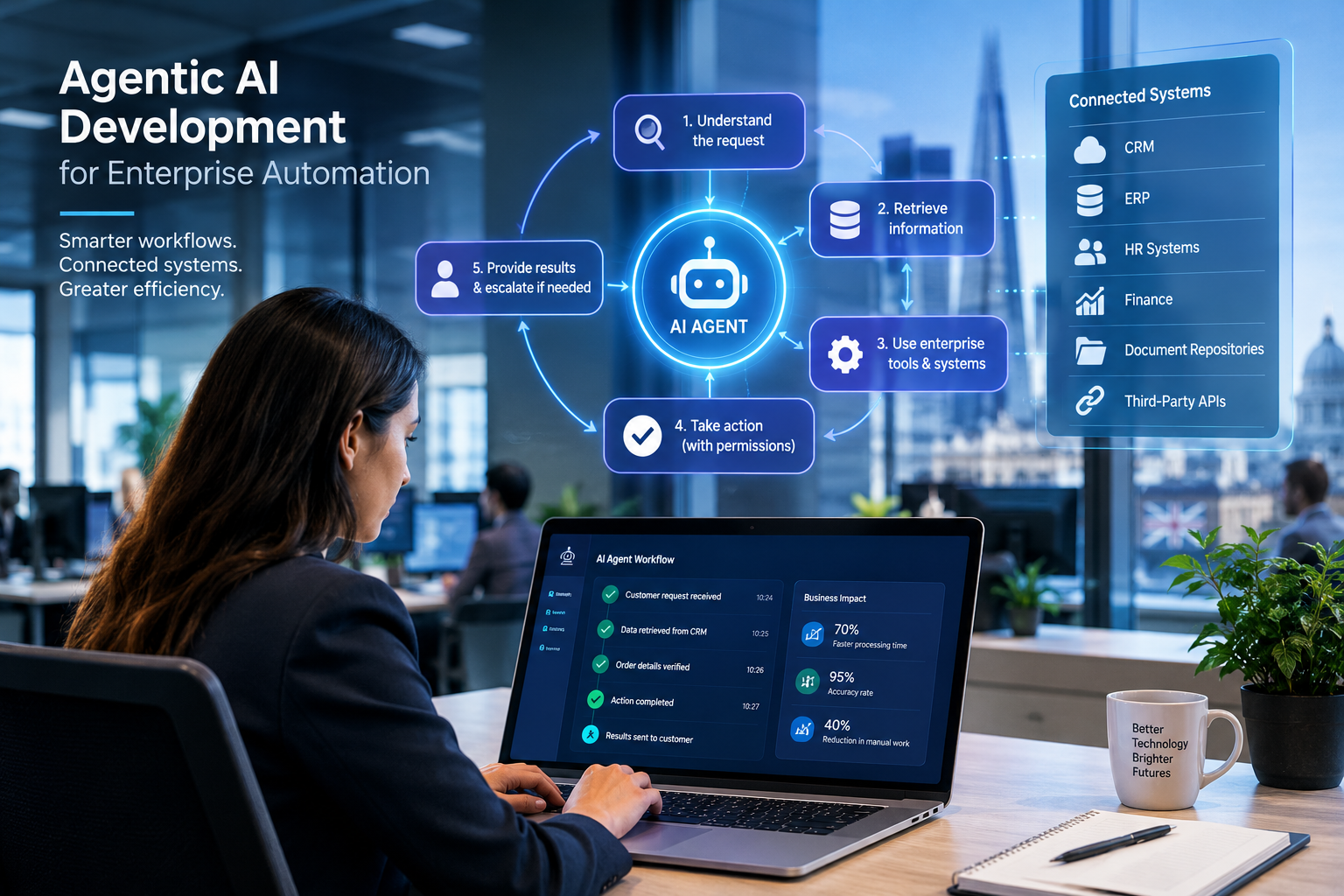
Businesses across the UK are exploring smarter ways to automate complex operations, improve customer experiences, and make faster decisions. Agentic AI development UK is becoming an important consideration for organisations that want artificial intelligence to do more than generate text or answer questions. AI agents can plan tasks, use approved tools, retrieve information, and take defined actions with varying levels of human supervision.
For financial services, SaaS platforms, healthcare operations, and manufacturing businesses, the opportunity lies in connecting AI capabilities to real workflows. However, successful implementation requires more than choosing an AI model. It demands reliable data, secure integrations, clear business objectives, and appropriate oversight.
What is agentic AI development in the UK? Agentic AI development involves designing and building AI-powered systems that pursue defined goals, plan multiple steps, use software tools, and adapt their actions based on results. UK businesses can use these systems to support customer service, document processing, operational planning, and internal decision-making, provided that access controls, testing, and human approval match the risks involved.
Agentic AI development refers to building software systems that work towards a goal rather than simply responding to a single instruction. An AI agent may interpret a request, retrieve relevant data, select an approved tool, perform an action, and check whether the task succeeded.
Traditional automation follows predetermined rules. Generative AI primarily produces content or answers. Agentic AI combines reasoning, tool use, and workflow execution, although its decisions can still be unreliable and require safeguards.
For example, a conventional customer support chatbot might explain a refund policy. An AI agent could retrieve the relevant order, check the policy, prepare a refund request, and route it for approval. The difference is its ability to coordinate multiple steps.
Common building blocks include:
The UK government’s AI Opportunities Action Plan, published in January 2025, identifies AI adoption as an important opportunity for productivity and economic growth. Its priorities include sectors such as financial services, life sciences, and advanced manufacturing. This provides useful context for businesses evaluating AI investment.
Read the UK government’s AI Opportunities Action Plan: One Year On.
The strongest use cases begin with repetitive, time-consuming workflows that have clear rules, accessible data, and measurable outcomes. Businesses should identify where agents can reduce manual coordination without introducing unacceptable risk.
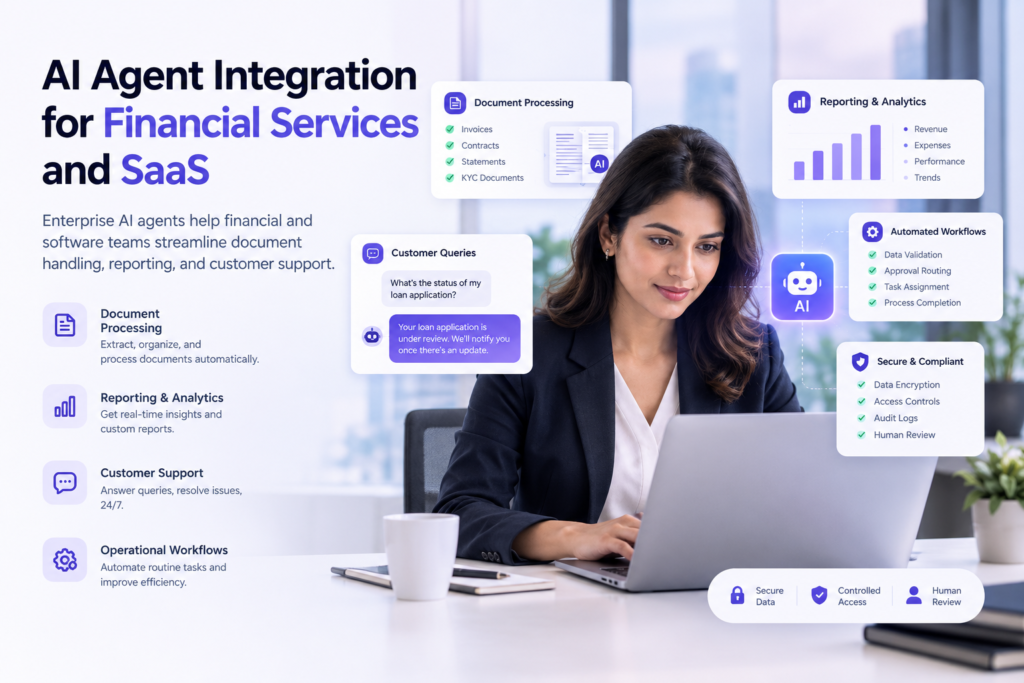
Financial institutions handle large volumes of documents, customer requests, policy information, and compliance-related tasks. Agentic AI can support these processes when access to sensitive data and decision-making authority are carefully controlled.
Potential applications include:
For instance, an insurance operations agent could assemble a claim summary from approved records and highlight missing evidence. A qualified employee would then review the findings and make the final decision.
Financial services require particular care. Automated financial recommendations, eligibility decisions, or claim outcomes may create legal, conduct, and consumer protection risks. Therefore, businesses should start with administrative assistance rather than unrestricted autonomous decisions.
SaaS providers can use AI agents to make products more useful and reduce support workloads. An agent embedded in a software platform might explain account activity, guide users through a process, or perform authorised actions through existing APIs.
Useful applications include:
However, agents need explicit permissions and reliable error handling. A support agent should not change billing details or delete customer records without the required authentication and authorisation.
Healthcare and life sciences organisations often coordinate appointments, documentation, research, inventory, and regulatory records. AI agents may help staff manage these activities while keeping clinical and scientific decisions appropriately supervised.
Examples include appointment coordination, administrative document preparation, research literature summarisation, and pharmaceutical supply monitoring.
A biotech team might use an agent to search approved research repositories, compare study documents, and prepare a summary for scientific review. The agent supports the research process; it does not establish that a treatment is safe or effective.
Patient confidentiality, data quality, clinical validation, and applicable UK data protection requirements must shape the design from the beginning.
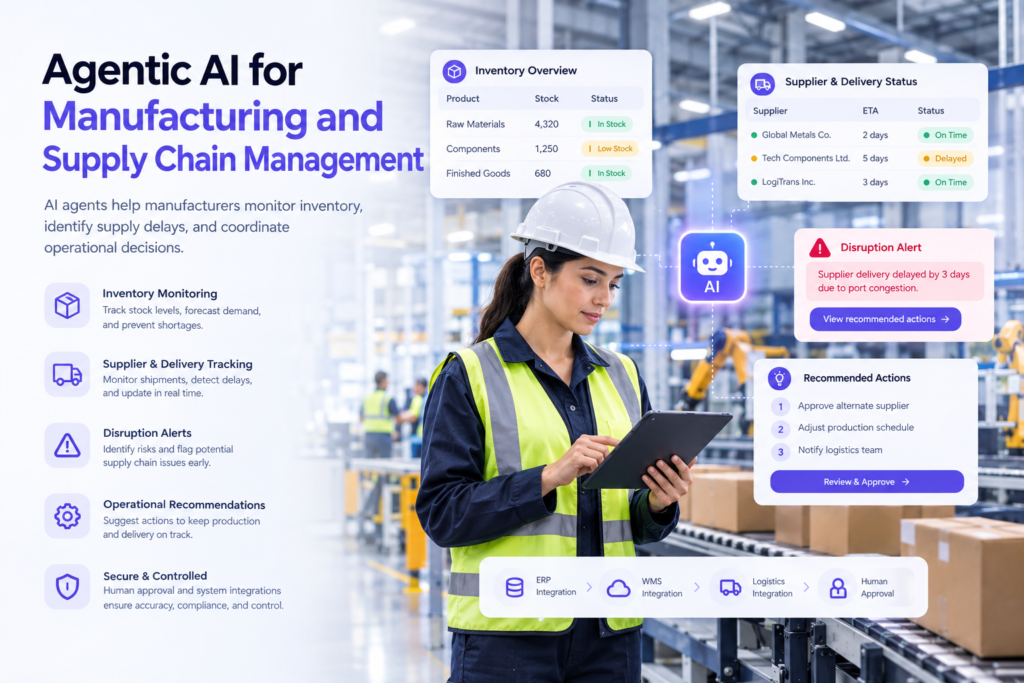
Supply chains depend on timely information from suppliers, warehouses, transport systems, and production schedules. AI agents can help teams respond to disruptions and coordinate routine decisions.
Potential applications include:
Imagine a manufacturer whose supplier reports a delayed shipment. An agent could check available inventory, identify affected production orders, compare approved alternatives, and recommend a revised schedule. A planner could approve the change before the system updates production commitments.
Successful agentic AI development UK projects combine software engineering, business process design, data governance, and continuous evaluation. The aim is not to make every process autonomous. It is to automate appropriate tasks while retaining control over consequential decisions.
A practical development process has six stages:
For governance, the NIST AI Risk Management Framework offers a useful voluntary reference for identifying and managing AI risks. UK organisations should also assess their obligations under applicable data protection, sector-specific, and consumer protection rules.
Neither approach is best for every task. The right choice depends on how predictable the workflow is and how much flexibility it needs.
| Consideration | Traditional automation | Agentic AI |
| Best suited to | Stable, rule-based processes | Variable, multi-step tasks |
| Decision method | Predetermined rules | Model-assisted planning and tool use |
| Predictability | Usually higher in defined conditions | Can vary between similar requests |
| Implementation | Often simpler for fixed workflows | Requires additional evaluation and controls |
| Oversight | Exception handling and rule monitoring | Permissions, monitoring, and human review |
A practical rule is to use conventional automation for deterministic tasks and agentic AI where interpreting context or coordinating steps creates meaningful value. A hybrid solution often delivers the best balance.
A capable development partner should translate business goals into a secure, maintainable solution. For UK organisations, that also means understanding the operating environment, customer expectations, data handling, and relevant sector requirements.
When evaluating a partner, ask for evidence of:
At The Brands Bureau, businesses can explore how software development, API integration, and AI-enabled workflows may support their digital transformation goals. The appropriate solution depends on your systems, data, and operational needs. A discovery discussion should establish feasibility before development begins.
Agentic AI development UK offers organisations a way to coordinate complex workflows, improve operational efficiency, and make better use of business information. However, results depend on choosing the right use case, integrating reliable systems, and maintaining appropriate human control.
For financial services, SaaS, healthcare, life sciences, logistics, and manufacturing, a focused and well-governed pilot is a sensible starting point. The Brands Bureau can help you explore software development and AI-enabled solutions aligned with your operational goals.
Ready to assess an AI opportunity for your business? Visit The Brands Bureau to discuss your requirements and identify a practical next step.
Generative AI creates content, summaries, or answers in response to prompts. Agentic AI uses AI capabilities to pursue a defined goal through multiple steps, potentially interacting with external tools and business systems. Agentic systems may use generative models, but they also require orchestration, permissions, monitoring, and mechanisms for handling errors.
The cost of agentic AI development in the UK depends on workflow complexity, integrations, data readiness, security requirements, model usage, and ongoing support. A limited proof of concept generally requires less investment than a production system connected to sensitive enterprise platforms. Request a scoped estimate based on deliverables, risks, and measurable acceptance criteria.
Financial services, insurance, SaaS, healthcare operations, life sciences, logistics, and manufacturing offer potential use cases because they involve complex information and coordinated workflows. However, the best opportunity depends on the individual organisation. Repetitive tasks with clear boundaries and accessible data are usually better starting points than high-risk decisions.
AI agents can be deployed responsibly when organisations apply appropriate permissions, testing, monitoring, data protection, and human oversight. They can still produce incorrect outputs or misuse available tools if poorly designed. Businesses should restrict access, test adversarial inputs, log actions, define escalation procedures, and require approval for consequential operations.
Start by selecting one measurable business problem, such as document preparation, support triage, or supplier-delay monitoring. Map the existing process, establish baseline performance, assess data access, and define acceptable risks. Then develop a limited pilot, test it against realistic scenarios, and expand only when it meets agreed performance and governance requirements.
Zeeshan Shafiq is a technology and digital transformation specialist at The Brands Bureau, focusing on SEO, software development, enterprise solutions, and AI-powered business innovation. Their work explores practical technology strategies that help businesses improve digital experiences, streamline operations, and make informed decisions.
Leave A Reply Now